


Crude Price Surge Strait of Hormuz Impact on Indian Equities
Share this article:
7 min readMarket intelligence indicates global crude oil prices could hit USD 150 per barrel if the Strait of Hormuz closes for 4-8 weeks. This geopolitical risk poses significant headwinds for Indian sectors like OMCs and aviation, while Nifty and Bank Nifty already show sharp declines.
Global crude oil prices face a significant upside risk, with intelligence indicating a potential surge to as high as USD 150 per barrel. This projection is contingent on the Strait of Hormuz remaining closed for an extended period of four to eight weeks, a scenario that would fundamentally alter global energy supply dynamics. Such a development would represent a substantial escalation in geopolitical risk, directly impacting commodity markets worldwide.
The Indian equity market is currently reflecting broader concerns, as evidenced by today's live market data. The NIFTY 500 is trading at 21391.20, marking a significant decline of -506.30 points or -2.31% from its previous close. Similarly, the NIFTY BANK has seen a sharp correction, currently at 53757.85, down -1343.10 points or -2.44%. While the immediate market downturn may not be solely attributed to this crude oil intelligence, the potential for a sustained crude price rally introduces a critical macroeconomic headwind that traders must integrate into their risk assessments.
Live Market Snapshot: Where Indices and Stocks Stand Today
As of the latest market data, Indian benchmark indices are experiencing notable declines:
- NIFTY 500: Opened at 21763.25, reached a high of 21780.75, and a low of 21351.10. The last traded price is 21391.20, reflecting a change of -506.30 points or -2.31% from its previous close of 21897.50.
- NIFTY BANK: Opened at 54592.05, with an intraday high of 54713.75 and a low of 53675.70. The index is currently trading at 53757.85, down -1343.10 points or -2.44% from its previous close of 55100.95.
No specific individual stock data was provided in the live market snapshot for analysis in this report.
Primary Market Trigger: What the Data Shows
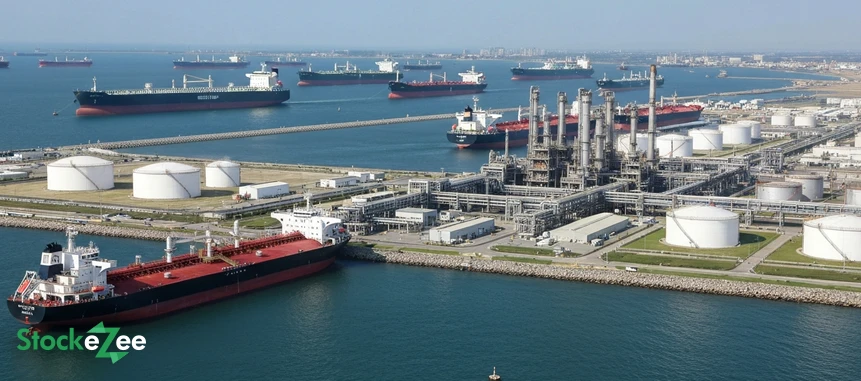
The core market trigger identified is the potential closure of the Strait of Hormuz for an estimated duration of four to eight weeks. This geopolitical event is the primary reason cited for the projected surge in global crude oil prices. The Strait of Hormuz is a critical chokepoint for global oil shipments, with a significant portion of the world's seaborne oil passing through it daily. A prolonged closure would severely restrict supply to international markets, creating an immediate and substantial supply-demand imbalance.
The mechanism behind the projected price surge is straightforward: reduced supply against persistent demand. This scenario would trigger a significant geopolitical risk premium on crude oil, driving prices upwards. While the intelligence did not provide specific historical patterns for a closure of this exact duration, past geopolitical tensions in the Middle East have consistently demonstrated the sensitivity of crude prices to supply disruptions in the region. The magnitude of a 4-8 week closure, however, suggests an impact far more severe than typical short-term disruptions, potentially pushing prices to unprecedented levels like the USD 150 per barrel forecast.
Sector Intelligence: Winners and Headwinds
The provided market intelligence did not explicitly identify specific sectors positioned positively or negatively. However, a sustained surge in global crude oil prices to USD 150 per barrel, driven by a Strait of Hormuz closure, would have distinct and significant implications across various Indian equity sectors.
Sectors positioned positively:
While no sectors were explicitly identified as positive, a prolonged crude price rally typically benefits upstream oil exploration and production companies. These entities would see a direct increase in their realizations per barrel, potentially boosting profitability. However, the Indian market has a limited number of pure-play upstream companies, and the broader economic impact of high crude could temper overall sentiment even for these beneficiaries.
Sectors facing headwinds:
A crude oil price surge of this magnitude would create substantial headwinds for several sectors. Oil Marketing Companies (OMCs) would face significant pressure on their marketing margins, especially if retail fuel prices are not fully adjusted to reflect international crude costs. Sectors with high energy consumption, such as manufacturing, chemicals, and cement, would experience increased input costs, impacting their operational profitability. Furthermore, the aviation and logistics sectors would see a direct rise in fuel expenses, which constitute a major portion of their operating costs. The broader economic impact of higher inflation and potential interest rate hikes, often associated with elevated crude prices, could also dampen consumer demand, affecting discretionary consumption sectors.
Stocks on the Radar
The market intelligence did not specify individual stocks likely to see buying interest or selling pressure. However, based on the sector-wide implications of a potential crude oil surge to USD 150 per barrel, traders should monitor stocks within the identified impacted sectors.
- Stocks likely to see buying interest: Traders might look for opportunities in companies that are net beneficiaries of higher crude prices, primarily those involved in oil exploration and production. These companies would experience improved revenue and profitability metrics. However, the overall market sentiment and the duration of the crude price surge would be critical factors.
- Stocks likely to face selling pressure: Companies in sectors such as Oil Marketing (e.g., Indian Oil, BPCL, HPCL), Aviation (e.g., IndiGo, SpiceJet), Logistics, and certain manufacturing and chemical companies with high energy intensity, would likely face increased scrutiny. Their profitability margins could be compressed due to higher input costs, potentially leading to selling pressure. Traders should assess the sensitivity of individual company margins to crude price fluctuations.
Historical Precedent and Pattern Recognition
The intelligence indicates no specific historical pattern for a Strait of Hormuz closure lasting four to eight weeks. This suggests that such a prolonged disruption would be a relatively unprecedented event in recent market history, particularly concerning its potential impact on global crude supply. While there have been numerous instances of geopolitical tensions in the Middle East leading to temporary spikes in crude prices, a sustained closure of this critical chokepoint for several weeks would represent a far more severe and systemic shock to the global energy market.
In past episodes of significant crude oil price spikes, Indian markets have typically reacted with increased inflationary concerns, pressure on the current account deficit, and a potential tightening of monetary policy. However, the scale of a USD 150 per barrel scenario, if realized, would likely trigger a more profound and sustained impact, potentially leading to a re-evaluation of economic growth forecasts and corporate earnings across a wide spectrum of industries. The absence of a direct historical precedent for this specific scenario means traders must rely more on fundamental supply-demand analysis and geopolitical developments rather than historical price action patterns.
Trader Implication: Reading the Next 1–5 Sessions
The primary trader implication is to monitor the Strait of Hormuz situation for a potential significant crude price surge. The market's immediate reaction to such a geopolitical risk would be swift, and the current downturn in indices like the NIFTY 500 at 21391.20 and NIFTY BANK at 53757.85 underscores the sensitivity to global headwinds. These levels could serve as immediate support zones, but a confirmed Strait closure would likely test lower levels.
The next session bias is NEUTRAL. While the potential for a crude price surge is a significant bearish factor, the market has already seen a substantial correction today. Further direction will heavily depend on any new developments regarding the Strait of Hormuz, official statements from global powers, and the actual duration of any potential closure. Traders should remain agile, focusing on risk management and closely tracking geopolitical headlines, as well as the price action in global crude oil futures. The market will likely consolidate or react sharply based on incoming news flow rather than a pre-determined directional bias.
Key Takeaways for Market Participants
- Global crude oil prices could surge to USD 150 per barrel if the Strait of Hormuz remains closed for 4-8 weeks.
- This scenario represents a critical geopolitical risk with significant implications for global energy markets.
- Indian benchmark indices, NIFTY 500 (currently at 21391.20) and NIFTY BANK (currently at 53757.85), are already showing significant weakness today.
- Sectors like Oil Marketing Companies, Aviation, Logistics, and energy-intensive manufacturing would face substantial headwinds due to increased input costs.
- Upstream oil exploration and production companies could see positive impacts, though overall market sentiment may remain cautious.
- The absence of historical precedent for such a prolonged Strait closure implies a potentially unprecedented market reaction.
- Traders must closely monitor geopolitical developments around the Strait of Hormuz and global crude oil price action.
- The next session bias is NEUTRAL, with market direction highly dependent on new information regarding the Strait.