


IRFC Shares Decline Government Divestment Triggers Supply Pressure
Share this article:
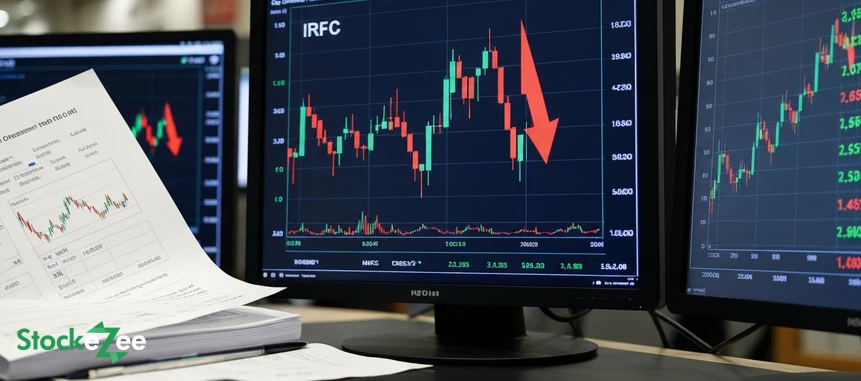
7 min readIRFC shares declined 4 percent as the government plans to divest a 4 percent stake via Offer for Sale. The floor price is set at Rs 104 per share. This analysis provides active Indian equity traders with insights into the immediate supply pressure and the bearish bias for the next sessions.
Indian Railway Finance Corporation (IRFC) shares experienced a significant downward movement, declining by 4% following the government's announcement of a planned divestment. This move introduces a substantial supply overhang into the market for the asset, directly impacting its immediate valuation and trading dynamics. The government intends to sell up to 4% of its stake in the company through an Offer for Sale (OFS), a mechanism that typically creates short-term price pressure due to increased share availability.
The broader Indian market context shows a mixed picture. The Nifty 50 index is trading positively, currently at 25589.40, marking a gain of 164.75 points or 0.65% from its previous close. In contrast, the Nifty Bank index is showing marginal positive movement, standing at 61075.70, up by 28.40 points or 0.05%. This divergence highlights that while the overall market sentiment might be cautiously optimistic, specific stock-level events, such as the IRFC OFS, can trigger distinct and immediate reactions, necessitating focused analysis for active traders.
Live Market Snapshot: Where Indices and Stocks Stand Today
As of the latest market data, the Nifty 50 index opened at 25512.60, reached a high of 25652.60, and recorded a low of 25507.90. Its last traded price is 25589.40, reflecting a change of 164.75 points and a percentage change of 0.65% from its previous close of 25424.65.
The Nifty Bank index commenced trading at 61175.05, observed a high of 61317.55, and a low of 61069.90. The index's last traded price is 61075.70, indicating a change of 28.40 points and a percentage change of 0.05% against its previous close of 61047.30.
No specific stock data was available in the live market snapshot for individual stock movements beyond the initial intelligence on IRFC.
Primary Market Trigger: What the Data Shows
The primary catalyst for the 4% decline in IRFC shares is the government's strategic decision to divest a 4% stake through an Offer for Sale (OFS). This mechanism involves the promoter (in this case, the government) selling existing shares to the public, thereby increasing the free float and overall supply of the stock in the market. For traders, this translates into an immediate supply-side pressure, as a large block of shares becomes available, often at a discount to the prevailing market price, or at a floor price designed to attract institutional and retail participation.
The floor price for this OFS has been set at Rs 104 per share. This specific price point acts as a critical reference for market participants, potentially influencing the stock's trading range leading up to and during the OFS period. The OFS is structured to begin on Wednesday for institutional investors, followed by retail investors on Thursday. This staggered approach allows institutional demand to be gauged first, which can then set a precedent for retail participation. Given that IRFC is the dedicated funding arm for Indian Railways and recently reported its highest-ever quarterly profit, the divestment is a strategic financial move rather than a reflection of operational weakness, yet it still creates a technical overhang.
Sector Intelligence: Winners and Headwinds
Based on the provided market intelligence, no specific sectors have been identified as being positively or negatively impacted by the IRFC divestment. The event is highly stock-specific, primarily affecting IRFC itself due to the direct increase in its share supply.
However, it is important for traders to understand that while the immediate impact is localized, government divestments in public sector undertakings (PSUs) can sometimes have broader, albeit subtle, implications. A successful OFS can be viewed positively as it demonstrates the government's commitment to fiscal management and capital market deepening. Conversely, an unsuccessful or poorly subscribed OFS could cast a shadow on investor appetite for other PSU offerings. Given IRFC's role within the railway ecosystem, any significant price volatility could indirectly be monitored by participants in the broader infrastructure and capital goods sectors, though no direct correlation is indicated by the current data.
Stocks on the Radar
- Stocks likely to face selling pressure:
- IRFC: The immediate and direct impact of the government's 4% divestment via OFS is concentrated on IRFC shares. The announcement of the Offer for Sale, coupled with a floor price of Rs 104 per share, inherently creates an increased supply of shares in the market. This supply overhang typically leads to selling pressure as existing shareholders might anticipate a lower price post-OFS, or arbitrage opportunities might arise for institutional players. The stock's initial 4% decline is a direct manifestation of this anticipated supply. Traders will be closely monitoring the subscription levels of the OFS, as strong demand could mitigate some of the downside, while weak demand could exacerbate selling pressure in the sessions following the OFS.
- Stocks likely to see buying interest:
- No specific stocks have been identified as likely to see buying interest based on the current market intelligence. The event is highly specific to IRFC.
Historical Precedent and Pattern Recognition
The market intelligence indicates no specific historical pattern for an event of this exact nature concerning IRFC. However, government Offers for Sale (OFS) in Public Sector Undertakings (PSUs) are not uncommon in the Indian equity markets. Historically, such divestments often lead to short-term price corrections in the respective scrip due to the sudden increase in supply. The depth and duration of this correction typically depend on several factors: the size of the OFS, the floor price relative to the prevailing market price, the overall market sentiment, and the fundamental strength of the company.
In many instances, PSU OFSs are priced at a discount to attract investors, which can create an immediate arbitrage opportunity for some, while others might view it as a signal for a new, lower equilibrium price. Post-OFS, if the company's fundamentals remain strong and market conditions are supportive, the stock often tends to recover over the medium term as the supply overhang is absorbed. The fact that IRFC recently reported its highest-ever quarterly profit could serve as a fundamental support for a potential recovery once the OFS-induced supply pressure subsides. Traders often observe the subscription rates, particularly from institutional buyers, as a key indicator of how quickly the market might absorb the new supply and stabilize the price.
Trader Implication: Reading the Next 1–5 Sessions
The immediate implication for traders is a clear signal of increased supply for IRFC shares, driven by the government's 4% OFS. The floor price of Rs 104 per share establishes a critical level that traders will monitor. The Offer for Sale commencing for institutional investors on Wednesday and for retail investors on Thursday implies that the stock could experience continued volatility and downward pressure in the very near term as the market digests this new supply.
Considering the specific event and its direct impact on supply-demand dynamics, the next session bias for IRFC is BEARISH. This bias is primarily driven by the technical overhang created by the OFS. While the broader market, as indicated by the Nifty 50 trading at 25589.40 and Nifty Bank at 61075.70, shows a relatively stable to positive trend, IRFC's movement is expected to be decoupled due to its specific corporate action. Traders should anticipate potential selling pressure and increased volume in IRFC, especially around the OFS floor price. Monitoring the subscription levels will be crucial for assessing the duration and intensity of this bearish bias.
Key Takeaways for Market Participants
- IRFC shares declined 4% following the government's plan to divest a 4% stake via Offer for Sale.
- The OFS floor price is set at Rs 104 per share, a critical level for short-term price action.
- The Offer for Sale begins Wednesday for institutional investors and Thursday for retail investors, indicating immediate supply pressure.
- The next session bias for IRFC is BEARISH due to the increased supply from the OFS.
- Nifty 50 is trading at 25589.40 (up 0.65%) and Nifty Bank at 61075.70 (up 0.05%), providing a stable broader market context.
- Traders should monitor OFS subscription rates closely as an indicator of demand absorption and potential price stabilization.
- Despite the divestment, IRFC's recent highest-ever quarterly profit provides a fundamental backdrop for potential medium-term recovery post-OFS.