


Nifty Faces Worst Month Since Covid Crash Amid Geopolitical Tensions and FII Selling
Share this article:
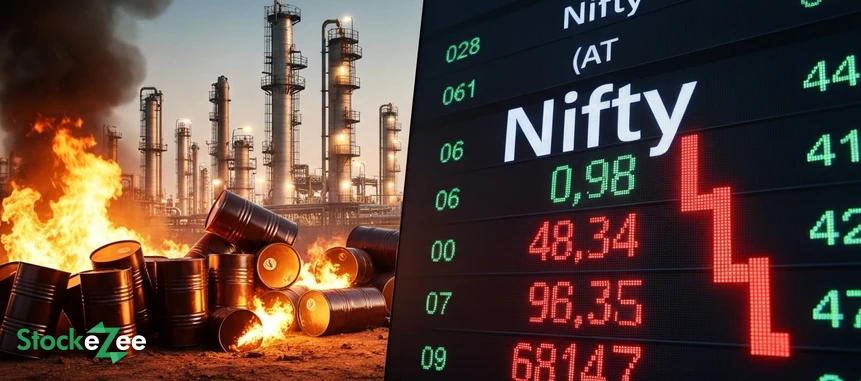
8 min readIndian equities are experiencing their sharpest monthly decline since the Covid crash, driven by the Iran war, rising crude oil prices, and significant FII selling. Despite this, fund houses point to strong domestic fundamentals as a potential stabilizer once geopolitical pressures ease. Traders face a bearish bias with key index levels under pressure.
Indian equities are currently navigating a period of significant volatility, marked by the Nifty experiencing its most substantial monthly decline since the Covid-19 induced market crash. This downturn reflects a confluence of geopolitical tensions and macroeconomic pressures, directly impacting trader sentiment and market positioning. The current market intelligence indicates a pronounced bearish bias, driven by external factors that have overshadowed domestic fundamentals.
As of the latest market snapshot, the NIFTY 500 has registered a notable decline, trading at 21391.20, down -506.30 points or -2.31% from its previous close. Similarly, the NIFTY BANK index has also seen considerable pressure, closing at 53757.85, a drop of -1343.10 points or -2.44%. This broad-based selling pressure underscores the market's reaction to the prevailing negative catalysts, prompting active traders to reassess their strategies and risk exposures.
Live Market Snapshot: Where Indices and Stocks Stand Today
The Indian equity market is currently reflecting significant downside momentum across key indices. The NIFTY 500 opened the session at 21763.25, reached an intraday high of 21780.75, and subsequently fell to a low of 21351.10. Its last traded price stands at 21391.20, marking a substantial decline of -506.30 points or -2.31% from its previous close of 21897.50.
Concurrently, the NIFTY BANK index has also experienced considerable selling pressure. It commenced trading at 54592.05, touched an intraday high of 54713.75, and recorded a low of 53675.70. The index's last traded price is 53757.85, representing a fall of -1343.10 points or -2.44% against its previous close of 55100.95.
No specific stock data was available in the live market snapshot for individual stock movements.
Primary Market Trigger: What the Data Shows
The primary catalyst for the current market downturn, as indicated by the intelligence data, is a combination of the Iran war, $100 crude oil prices, and heavy FII selling. These factors have collectively hammered sentiment across Indian equities. For active traders, the Iran war introduces significant geopolitical risk, which typically leads to a flight to safety and increased volatility. The direct impact on crude oil prices, pushing them towards the $100 per barrel mark, is particularly detrimental for India, a net oil importer. Higher crude prices translate to increased import bills, inflationary pressures, and potential current account deficits, all of which are negative for corporate earnings and economic growth prospects.
The concurrent heavy FII (Foreign Institutional Investor) selling exacerbates this pressure. FIIs often withdraw capital from emerging markets like India during periods of global uncertainty or when domestic economic outlooks are clouded by external shocks. This selling pressure directly impacts liquidity and can lead to sharp declines in index values. The historical pattern observed is that this marks the worst month for Nifty since the Covid crash. This comparison highlights the severity of the current market environment, suggesting a level of fear and uncertainty not seen since a major global economic disruption. Traders should note that such broad-based selling, especially from institutional players, often indicates a shift in risk appetite and can sustain downward momentum in the short to medium term.
Sector Intelligence: Winners and Headwinds
The current market intelligence does not specifically identify sectors positioned positively or facing headwinds. However, given the broad-based decline in both the NIFTY 500 and NIFTY BANK, it can be inferred that most sectors are experiencing significant pressure. The primary market triggers—geopolitical conflict, elevated crude oil prices, and FII selling—tend to have a pervasive negative impact across the economy.
Sectors that are typically sensitive to crude oil prices, such as airlines, logistics, and paint manufacturers, would likely face increased input costs and margin compression. Similarly, sectors reliant on discretionary consumer spending might see demand contraction due to inflationary pressures. Financials, represented by the Nifty Bank's substantial decline, are also under pressure, potentially due to concerns over economic growth and asset quality in a high-interest rate, high-inflation environment. Traders should monitor sector-specific news and earnings reports closely for any divergence from the broader market trend, although the current environment suggests widespread headwinds rather than isolated sector strength.
Stocks on the Radar
The provided market intelligence does not specify individual stocks likely to see buying interest or face selling pressure. This suggests that the current market movement is largely index-driven and sentiment-based, rather than being concentrated in specific scrips due to company-specific news.
In an environment characterized by the Nifty's worst month since the Covid crash and significant FII selling, the general tendency is for a broad-based decline, where even fundamentally strong stocks may experience selling pressure due to overall market sentiment and liquidity withdrawal. Traders should therefore focus on the broader market indices and their key constituents. Any stock exhibiting relative strength during such a downturn could be indicative of underlying resilience or specific positive catalysts, but such instances are likely to be exceptions rather than the norm.
Conversely, stocks with high foreign institutional ownership or those in sectors particularly vulnerable to rising crude oil prices and geopolitical instability are likely to face intensified selling pressure. Without specific stock data, traders are advised to apply a cautious approach, focusing on risk management and observing how individual stocks react to the prevailing bearish sentiment and potential support levels.
Historical Precedent and Pattern Recognition
The current market situation, characterized by the Nifty experiencing its worst month since the Covid crash, draws a significant historical parallel. The Covid-19 crash in March 2020 saw Indian markets, including the Nifty, undergo a sharp and rapid decline, driven by unprecedented global uncertainty and economic lockdowns. That period was marked by extreme volatility, significant FII outflows, and a complete re-evaluation of global growth prospects. The depth of that crash was substantial, with the Nifty falling over 35% from its peak in a very short span.
While the current triggers (Iran war, $100 crude, FII selling) differ from a global pandemic, the magnitude of the Nifty's monthly decline being compared to that period underscores the severity of the present sentiment. Historically, such sharp, fear-driven corrections often lead to capitulation before a potential bottom is formed. The recovery pattern post-Covid was V-shaped, fueled by massive global liquidity injections and a rapid economic rebound once lockdowns eased. However, the current geopolitical and inflationary environment presents a different set of challenges, potentially implying a more protracted period of consolidation or a U-shaped recovery rather than an immediate bounce back.
Traders should recognize that while the comparison highlights extreme fear, the underlying economic conditions and policy responses may not mirror 2020. The current situation demands a nuanced understanding of how these specific triggers might influence market duration, depth, and eventual recovery, rather than assuming an identical pattern.
Trader Implication: Reading the Next 1–5 Sessions
Based on the current market intelligence and live data, the next session bias is BEARISH. The confluence of the Iran war, elevated crude oil prices, and sustained FII selling creates a challenging environment for Indian equities. The Nifty's significant decline to 21391.20 and the Bank Nifty's fall to 53757.85 indicate strong downward momentum that is unlikely to reverse immediately without a significant positive catalyst.
Fund houses like Bajaj Finserv AMC and Axis Mutual Fund suggest that strong earnings and resilient fundamentals in India may steady markets once geopolitics stabilise. However, this implies that the immediate future remains dictated by external factors. For the next 1-5 sessions, traders should anticipate continued volatility and potential downside pressure. Key support levels for the Nifty would be crucial to monitor, with the current low of 21351.10 serving as an immediate reference point. A breach of this level could open doors for further declines. Similarly, for the Bank Nifty, the intraday low of 53675.70 is a critical level to watch.
Positional traders might consider defensive strategies or reduced exposure until there is clearer evidence of geopolitical de-escalation or a reversal in FII selling trends. Intraday traders should remain agile, focusing on price action around key support and resistance levels, acknowledging the prevailing bearish sentiment.
Key Takeaways for Market Participants
- The Nifty has experienced its worst monthly performance since the Covid crash, signaling extreme market fear.
- Live data shows the NIFTY 500 trading at 21391.20, down -2.31%, while NIFTY BANK is at 53757.85, down -2.44%.
- Primary market triggers are the Iran war, $100 crude oil, and heavy FII selling, creating a triple negative impact.
- The comparison to the Covid crash highlights the severity of current market sentiment and potential for sustained volatility.
- Fund houses believe strong Indian fundamentals could provide stability, but only after geopolitical factors subside.
- The next session bias is BEARISH, with Nifty's 21351.10 and Bank Nifty's 53675.70 as immediate support levels to monitor.
- Traders should prioritize risk management and observe global geopolitical developments and FII flow data closely.