SMA Screener — Live NSE Stocks by Simple Moving Average Conditions
Discover NSE stocks matching real-time SMA conditions with StockeZee's free SMA Screener. Filter stocks by Price Cross Above/Below SMA, Price Just Above/Below SMA, and SMA Bullish & Bearish Crossovers across 5, 10, 15, 20, 25, 30, 40, 50, 100, and 200 SMA periods. Perfect for positional traders and investors who rely on simple moving averages for trend identification in the Indian stock market.
What is an SMA Screener?
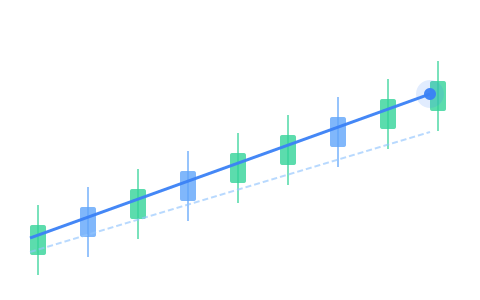
An SMA (Simple Moving Average) Screener filters stocks based on their price relationship with key simple moving averages. SMA calculates the average closing price over a specified number of periods, giving equal weight to each period. It is widely used by traders and investors to identify trend direction, support/resistance levels, and potential reversal points. StockeZee's SMA Screener covers six condition types — Price Cross Above SMA, Price Cross Below SMA, Price Just Above SMA, Price Just Below SMA, SMA Bullish Crossover, and SMA Bearish Crossover — across 10 SMA periods from 5 to 200.
SMA Screener Categories
Price Cross Above SMA: Stocks where the closing price has just crossed above a specific SMA — a bullish signal indicating potential trend reversal or continuation upward.
Price Cross Below SMA: Stocks where the closing price has just crossed below a specific SMA — a bearish signal indicating potential downward trend.
Price Just Above SMA: Stocks trading slightly above a specific SMA — useful for identifying stocks in an uptrend or near dynamic support.
Price Just Below SMA: Stocks trading slightly below a specific SMA — useful for identifying stocks near dynamic resistance or in a downtrend.
SMA Bullish Crossover: Stocks where a shorter SMA has crossed above a longer SMA (e.g., 5 SMA crossing above 20 SMA) — a classic golden cross signal for trend reversal.
SMA Bearish Crossover: Stocks where a shorter SMA has crossed below a longer SMA (e.g., 5 SMA crossing below 20 SMA) — a classic death cross signal for trend reversal.
How to Use the SMA Screener for Trading
Select SMA Condition: Choose from Price Cross Above/Below, Just Above/Below, or Bullish/Bearish Crossover based on your trading or investment strategy.
Pick SMA Period: Select the SMA period (5, 10, 15, 20, 25, 30, 40, 50, 100, or 200) — 50 SMA and 200 SMA are widely used for positional and long-term analysis.
Analyze Results: Review screened stocks with Close Price, LHS Value, RHS Value, and Diff to understand the signal strength and price-SMA relationship.
Confirm with Charts: Use TradingView integration to verify SMA signals with volume, RSI, and other technical indicators before entering trades.
Frequently Asked Questions
The 200 SMA (200-day Simple Moving Average) is one of the most widely followed technical indicators. It represents the average closing price over the last 200 trading days and is used to identify the long-term trend. Stocks trading above the 200 SMA are generally considered in a long-term uptrend, while stocks below it are in a downtrend. Institutional investors and fund managers closely watch the 200 SMA as a key support/resistance level.
A Golden Cross occurs when a shorter SMA (like 50 SMA) crosses above a longer SMA (like 200 SMA), signaling a potential long-term bullish trend reversal. A Death Cross occurs when a shorter SMA crosses below a longer SMA, signaling a potential long-term bearish trend. These are widely watched signals by institutional and retail traders for major trend changes.
For swing trading (holding positions for 2-10 days), the 20 SMA and 50 SMA are most commonly used. The 20 SMA acts as dynamic support in uptrends and resistance in downtrends. The 50 SMA is used for medium-term trend identification. Price crossing above the 20 SMA or 50 SMA with volume confirmation is a popular swing trading entry signal.
SMA gives equal weight to all periods in the calculation, making it smoother and slower to react to price changes. EMA gives more weight to recent prices, making it faster and more responsive. For trend-following and long-term analysis, SMA is preferred. For short-term momentum and intraday trading, EMA is more commonly used. Both have their place in a comprehensive trading strategy.
Start screening NSE stocks with SMA conditions on StockeZee — identify trend reversals, crossovers, and momentum setups in real-time. Free forever.